Strength training for partner acrobatics
A guide to getting started

TL;DR: If you do partner acro (or really any sport), you’ll get a huge return to strength training. Some lifts are especially well suited to acro. You’ll progress faster with a coach, a program or classes (I’ve listed a bunch—reach out if you’d like me to include you on the list). I describe my current workouts and 1rms.
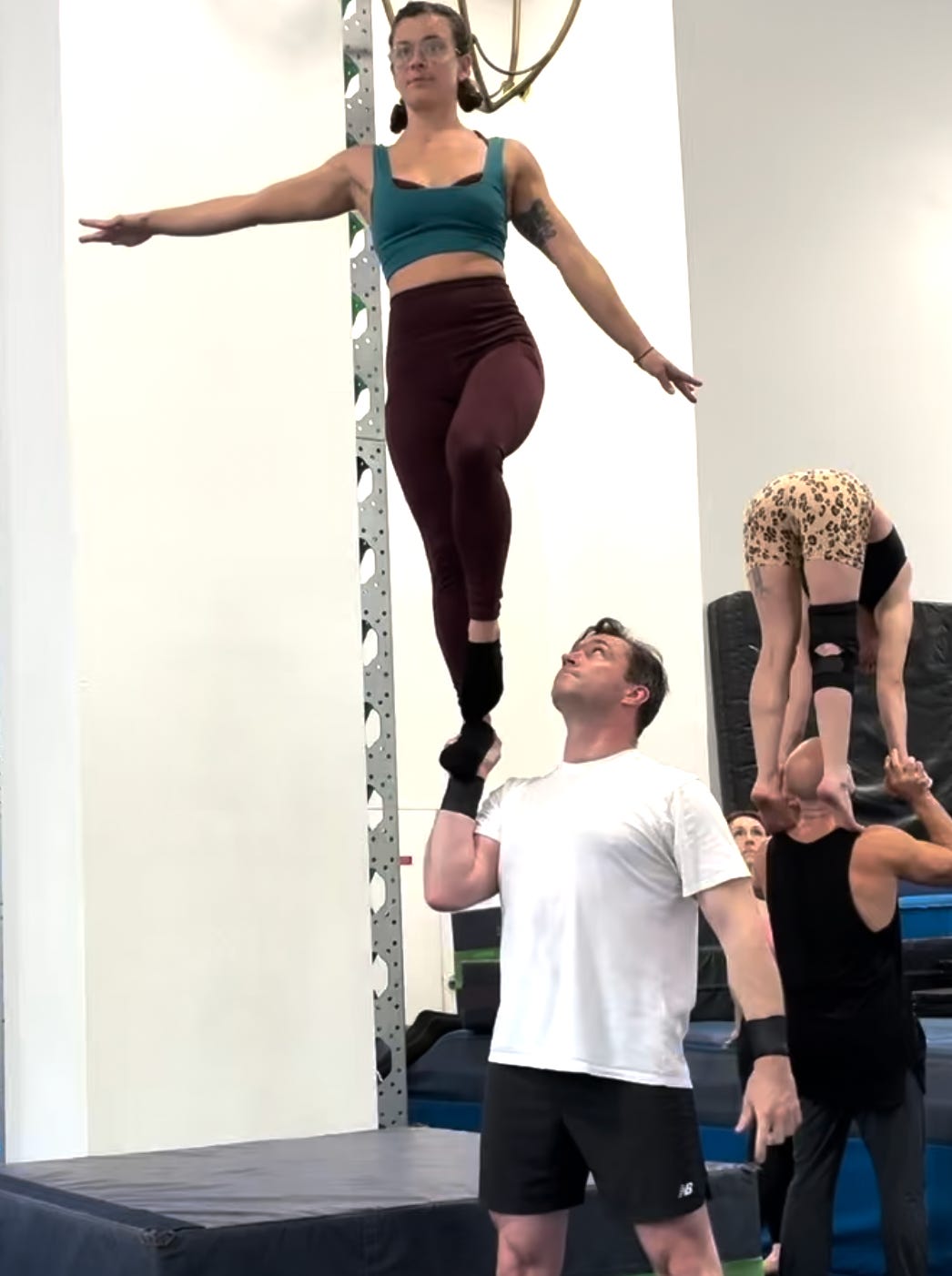
Lifting
This post is a long answer to this message I received today.
A few years ago, after a second rotator cuff strain, the wonderful circus PT Emily Lesinski asked “what are you doing in the weight room?” It was a productive prompt: I had injured both wrists, both shoulders and my back doing acro. These injuries happened mostly because I wasn’t strong enough for the sort of acro I’d started to enjoy.
In the few years since, I’ve built a good habit of strength training—3-4 days a week—and it’s helped a ton with my acro (and life in general). My flyers apparently appreciate this investment, and I’m known as a fairly strong base.
This piece is written for enthusiastic folks (especially bases and mids) who’d like to become stronger acrobats. Flyers should absolutely do strength training too, I just know a lot less about the demands of flying. Disclaimer: I’m not a personal trainer or strength coach (and I suggest you get one).
A few of helpful ideas in strength training
You adapt to the thing you train
The whole point of strength training is to force your body to change. These adaptations occur in response to (good!) stresses you force various tissues to endure. Without challenging yourself enough—typically not enough load or volume—you’ll see few adaptations. The real advantage of weight training (as opposed to getting strong just doing acro) is that you can expose yourself to much more stress in a more controlled environment—forcing greater adaptation with less risk.
The fastest way to halt progress is to get injured
While you need stress to get stronger, more isn’t always good; overtraining and injury are real threats to progress. Over time you’ll get a well calibrated sense of how much stress is appropriate and likely to generate stress without injury. It’s worth reading up on methods like “Reps in reserve” and “Rating of perceived exertion” as a way of gauging how much work you’re doing. Starting with lower weights and a coach can help you avoid injury.
(NB. many avoid injury too assiduously and never make progress.)
Progressive overload
A tried and true way to make sure your body continues to experience stress even as it adapts and becomes stronger is through progressive overload: over time, gradually adding more weight to the bar or adding reps to your sets.
This is about as close to a magical principle as there is. Simply showing up and adding a little bit each session has enormous effects on strength over time.
Programming
Programs are fixed cycles (often 12 weeks) of training grouped into phases that each have a specific goal. In this way, programs often have a narrative arc, with the phases supporting each other. As a new lifter, I highly recommend starting with and completing a full program. You’ll get exposed to a lot of lifts and get an idea of how quickly you’re able to progress.
Lifting for acrobats
Acro basing places a few fairly unique stresses on the body (flying does too!):
Overhead catches (eg. pitch to bird)
Explosive throws (pitching, banq, inlocates/relocates, jägers)
Heavy isometric holds (three high, f2h, h2h, monos/one arms)
Explosive twisting, lifts and throwing in adagio—similar to judo or BJJ?
Pressure in wrist extension (f2h, h2h).
My approach to choosing training targets is to work backwards from the parts of the skill where I am currently unstable or limited by strength. For example, following a shoulder injury last year, my left mono h2h/f2h is very shaky. And so right now I do a lot of heavy isometric holds with one arm.
But there are really a few basic lifts that bases and mids (and probably flyers too) just won’t regret doing. I’ve linked to a few videos that give an idea of how they translate to acro.
Overhead press: great for f2h/h2h, adagio.
Push press (and the “acro push press”): builds connection + power for dynamics.
Deadlift: develops back and core strength, stability
Squat: for stability, three highs.
Something explosive: weighted box jumps, cleans, kettle bell pulls
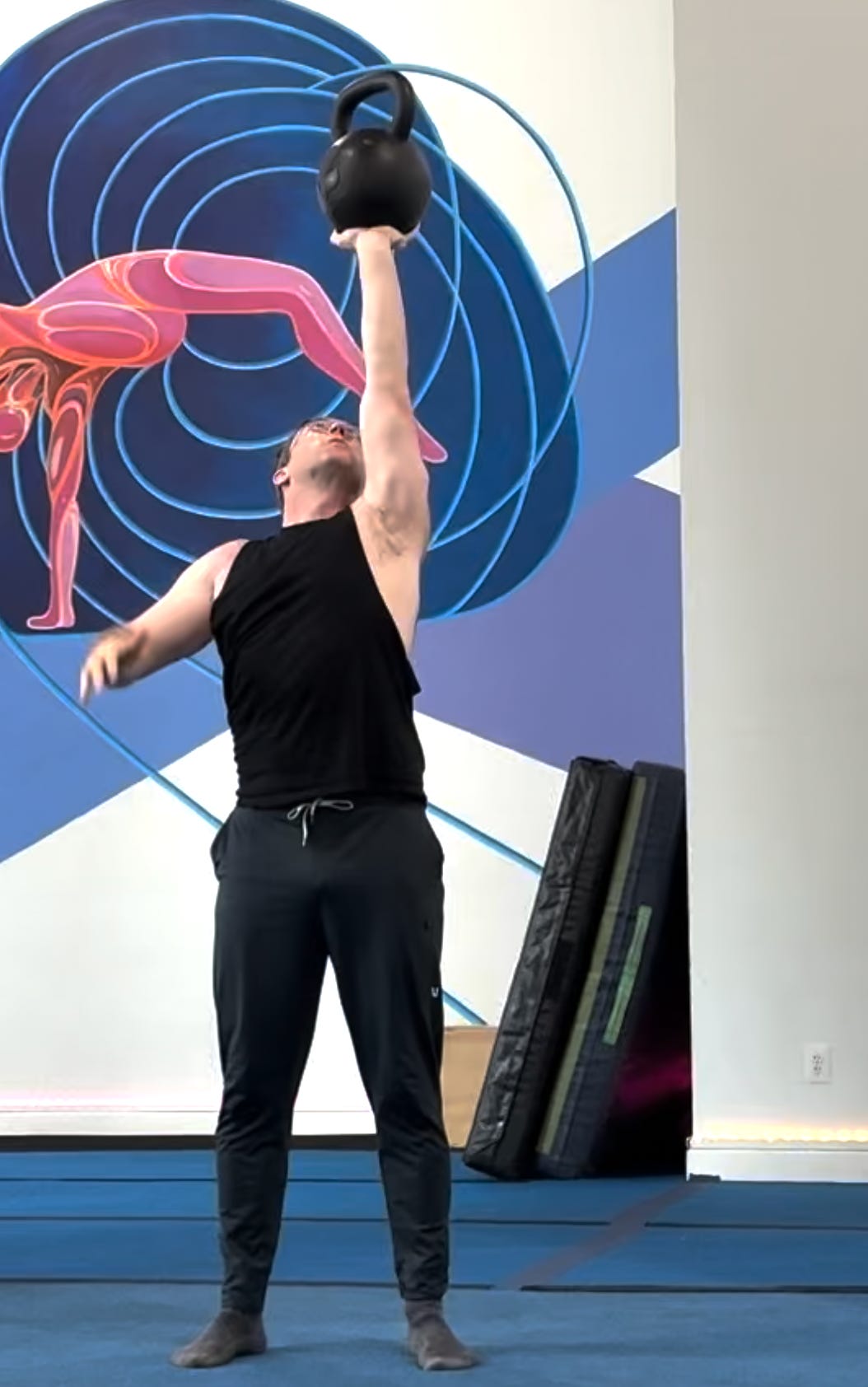
Heavy isometric front rack holds, overhead holds, javelin holds (and marches).
Some programs and coaches who specialize in acro strength
Here’s a list of trainers and programs who specialize in strength training for acrobats. They’re all accomplished acrobats themselves, and so have a very good idea of what is truly required.
Perform Athlete (remote)
Andy Phillips (NYC)
Jeremy Martin (NYC)
Sirus Bouchat (Chicago)
Ryan Hamity (Asheville)
John Thorpe (Connecticut, Seattle and remote)
My current training
I try for at least three weight training sessions a week, plus 2-3 acro sessions a week. I’m not currently working to a program (and progressed much faster when I was), but I find that this works fine for me and the numbers are still increasing.
Session 1: deadlift, push, pull
Deadlift (or variants like RDLs, heavy good mornings or trap bar deadlifts), normally for 5x5
Overhead push work like strict press (or javelin press, push press), normally 5x5
Barbell rows (or cable rows), 5x5
Accessories work
Fun lifts.
Session 2: squat, push, pull
Squat (or variants like front squat, leg press, trap bar dl, Bulgarians) 5x5
Pull up (or lat pull-downs, ring pull-ups) 5x7
Bench press (I hate bench, so much more commonly: floor press, dumbbell press, incline press or dips) 5x5
Accessory work
Fun lifts.
Session 3: power
Weighted box jumps
Olympic lifts (alternating between snatch drills and clean drills)
Push presses
Stair Master.
Accessory work for me focuses either on specific weakness in acro (eg. static javelin holds), or to refine issues in my main lifts. For example, my deadlift is limited by my lower back, and so I spend a lot of time doing weighted hypers on deadlift days.
Fun lifts often include: salsa dancing with 315lbs in front rack, Turkish get-ups, handstands, one-arm snatches or other silly things. You should have fun!
My current stats (205lb bw, 5’11”, 39yo)
After roughly 2 years of training, my lifts are roughly somewhere between intermediate and advanced according to the benchmarks listed on Strength Level. I’m not going to enter any lifting competition soon, and this level seems perfectly adequate for the sort of acro that I do.
Strict press 175lb; push press 235lb; squat 360lb; deadlift 450lb; bench press 225lb; turkish get-up (barbell) 145lb; power clean (I can’t clean properly) 185lb; power snatch (I can’t snatch properly) 145lb.